

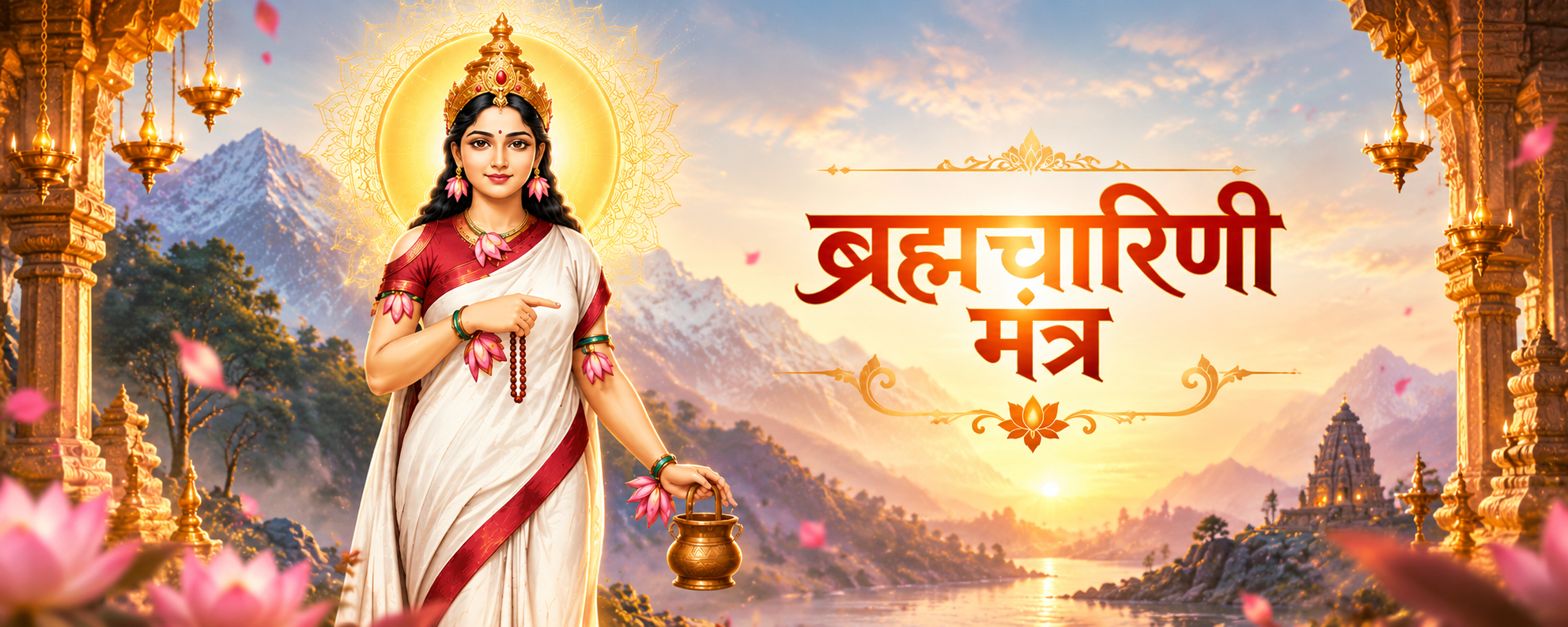
On the second day of Navratri, devotees worship Goddess Brahmacharini, the second manifestation of Goddess Durga. She embodies unwavering devotion, spiritual discipline, patience and the strength that arises from sincere penance. Her divine form reminds us that the path to spiritual fulfilment requires dedication, inner purity and complete faith in the Divine.
Goddess Brahmacharini represents the power of tapasya — the practice of spiritual austerity through meditation, self-control and steadfast determination. Her life teaches us that true strength does not always express itself through outward power; sometimes, it is found in silence, perseverance and the ability to remain committed to a higher purpose.
The Divine Form of Goddess Brahmacharini
Goddess Brahmacharini is depicted in a serene and graceful form, radiating peace, simplicity and spiritual strength. Unlike the more elaborate and ornamented forms of the Divine Mother, She is traditionally portrayed wearing simple white garments, symbolising purity and renunciation.
She carries a japa mala, or rosary, in one hand and a kamandalu, a sacred water vessel, in the other. The rosary represents prayer, meditation and continuous remembrance of the Divine, while the kamandalu signifies ascetic life and spiritual discipline.
Her calm expression reflects the profound concentration and inner determination with which She undertook her spiritual journey. As the unmarried form of Goddess Parvati, Brahmacharini represents the stage of divine aspiration in which devotion becomes the guiding force of life.
Her appearance conveys a timeless message: simplicity of life and purity of intention can become powerful foundations for spiritual growth.
What Does Goddess Brahmacharini Represent?
Goddess Brahmacharini symbolises the virtues necessary for anyone seeking a deeper understanding of life and spirituality. Her divine presence inspires devotees to cultivate patience, discipline, wisdom and unwavering faith.
1. Tapasya and perseverance
Tapasya is more than physical austerity. It is the ability to remain committed to a higher purpose despite difficulties, distractions and uncertainty. Brahmacharini Devi teaches us the importance of perseverance and the strength that comes from disciplined spiritual practice.
2. Devotion and surrender
Her devotion to Lord Shiva illustrates the depth of faith that remains unshaken by external circumstances. She reminds us that sincere devotion is not merely an expression of emotion but a continuous commitment of the mind, heart and spirit.
3. Control over the senses
Spiritual progress requires awareness of our thoughts, desires and actions. The Goddess inspires devotees to develop self-restraint, overcome distractions and direct their energy towards meaningful goals.
4. Knowledge and inner wisdom
Through meditation and contemplation, the mind gradually becomes calmer and more receptive to deeper understanding. Brahmacharini Devi represents the wisdom that develops when we turn our attention inward.
5. Courage during difficult times
Her long period of penance demonstrates that challenges need not weaken our determination. With patience, faith and discipline, difficulties can become opportunities for inner transformation.
During Navratri, devotees honour the Goddess through prayer, mantra chanting, meditation and other spiritual observances. These practices offer an opportunity to cultivate the qualities She represents and bring greater awareness into everyday life.
The Sacred Legend of Goddess Brahmacharini
According to Hindu tradition, Goddess Brahmacharini is associated with the spiritual journey of Goddess Parvati and Her determination to unite with Lord Shiva.
Parvati was born to Himavan, the king of the mountains, and his wife, Menavati. From an early age, She developed a deep attraction towards Lord Shiva and aspired to accept Him as Her divine consort.
At that time, Lord Shiva was immersed in meditation and had withdrawn from worldly life. Undeterred by the difficulties of Her chosen path, Parvati resolved to undertake intense penance to demonstrate the depth of Her devotion.
She began Her austerities by consuming fruits and flowers. As Her penance continued, She gradually renounced these as well. According to traditional accounts, She eventually gave up food and water, dedicating Herself entirely to meditation and spiritual contemplation.
Her extraordinary determination earned Her the name Brahmacharini — the Goddess who follows the path of spiritual discipline and penance.
Tradition further recounts that Lord Shiva, wishing to test Her devotion, appeared before Her in the guise of an elderly ascetic. He spoke critically of Shiva, attempting to dissuade Parvati from Her resolve. However, She firmly defended the Lord and remained unwavering in Her devotion.
Recognising the depth of Her faith, Lord Shiva revealed His true identity and accepted Her devotion. Their divine union represents the meeting of consciousness and energy, a profound theme in Hindu spiritual philosophy.
The story of Brahmacharini is therefore not merely a tale of divine love. It is also a teaching on determination, spiritual commitment and the transformative power of unwavering faith.
The Spiritual Significance of Brahmacharini
The deeper significance of Goddess Brahmacharini extends beyond the story of penance. Her name invites contemplation on the nature of consciousness, the movement of life and the journey towards spiritual realisation.
The word Brahma is associated with the ultimate reality or infinite consciousness, while charini conveys the sense of one who follows or moves along a particular path. In a spiritual interpretation, Brahmacharini can thus be understood as the one who moves towards or abides in the infinite.
This understanding encourages us to look beyond the limitations of ordinary perception. What appears still on the surface may contain profound movement and activity within. Just as the vastness of space accommodates countless forms of motion, the spiritual dimension of existence invites us to recognise a reality deeper than what the senses immediately reveal.
Brahmacharini Devi also represents the freshness and purity of spiritual energy. Her form reminds us that the spiritual journey is not simply a repetition of old practices; every moment offers an opportunity to approach life with renewed awareness.
Like the sunlight that appears anew each morning, spiritual understanding can be rediscovered through sincere practice. Meditation, contemplation and disciplined living allow us to experience familiar truths with greater clarity and depth.
Her worship during Navratri therefore becomes an invitation to renew our commitment to inner growth and discover the stillness, strength and wisdom within ourselves.
Lessons We Can Learn from Goddess Brahmacharini
The life and symbolism of Brahmacharini Devi offer valuable lessons for modern life.
- Remain committed to your purpose: Meaningful achievements require patience and consistent effort.
- Practise self-discipline: Learning to direct our thoughts, habits and actions helps us live with greater clarity.
- Cultivate inner silence: Taking time for meditation and reflection can help us respond to life’s challenges with awareness.
- Develop unwavering faith: Difficult circumstances need not determine the strength of our inner resolve.
- Choose simplicity and sincerity: A peaceful mind and honest intention are valuable foundations for spiritual development.
These lessons are relevant not only to spiritual seekers but also to anyone striving to live a more conscious, balanced and purposeful life.
Worship of Goddess Brahmacharini During Navratri
The second day of Navratri is traditionally dedicated to the worship of Brahmacharini Devi. Devotees observe prayers, recite sacred mantras, practise meditation and undertake fasting according to their individual traditions and capacity.
Such observances are an opportunity to cultivate devotion, patience and mental discipline. Rather than focusing solely on external rituals, devotees may also use this sacred occasion to reflect on their inner lives and strengthen their commitment to spiritual practice.
Goddess Brahmacharini is traditionally associated with blessings for wisdom, perseverance, spiritual progress and the strength to overcome difficulties. Her worship inspires us to approach our spiritual journey with humility, sincerity and dedication.
Brahmacharini Devi and the Path of Kriya Yoga
The message of Brahmacharini Devi has a meaningful connection with the principles of disciplined spiritual practice. Her life reminds us of the importance of dedication, inward attention and the steady refinement of our awareness.
Kriya Yoga offers a path of spiritual practice through which sincere seekers can deepen their self-awareness and cultivate a more harmonious relationship between body, mind and consciousness.
The observance of Navratri can therefore serve as a reminder to make time for inner stillness, strengthen our spiritual discipline and approach our daily lives with greater mindfulness.
Through the teachings and spiritual guidance shared by Paravoor Sudheesh of Kriya Yoga International, seekers can explore the importance of regular practice, self-awareness and the journey towards inner transformation.
The essence of Brahmacharini Devi’s message is that spiritual growth unfolds through sincerity, patience and sustained effort. When our actions are guided by awareness and our minds remain committed to a higher purpose, every step of life can become part of our spiritual journey.
Conclusion: Discover the Strength Within
Goddess Brahmacharini stands as a timeless symbol of devotion, penance and the power of spiritual determination. Her journey teaches us that the pursuit of truth requires more than desire; it calls for patience, discipline and an unwavering commitment to the Divine.
As we worship Her on the second day of Navratri, may Her divine qualities inspire us to overcome distractions, deepen our spiritual practice and discover the peace and wisdom that arise from within.
May the blessings of Brahmacharini Devi guide every seeker towards greater awareness, inner strength and spiritual fulfilment.
Kriya Yoga International
Paravoor Sudheesh