
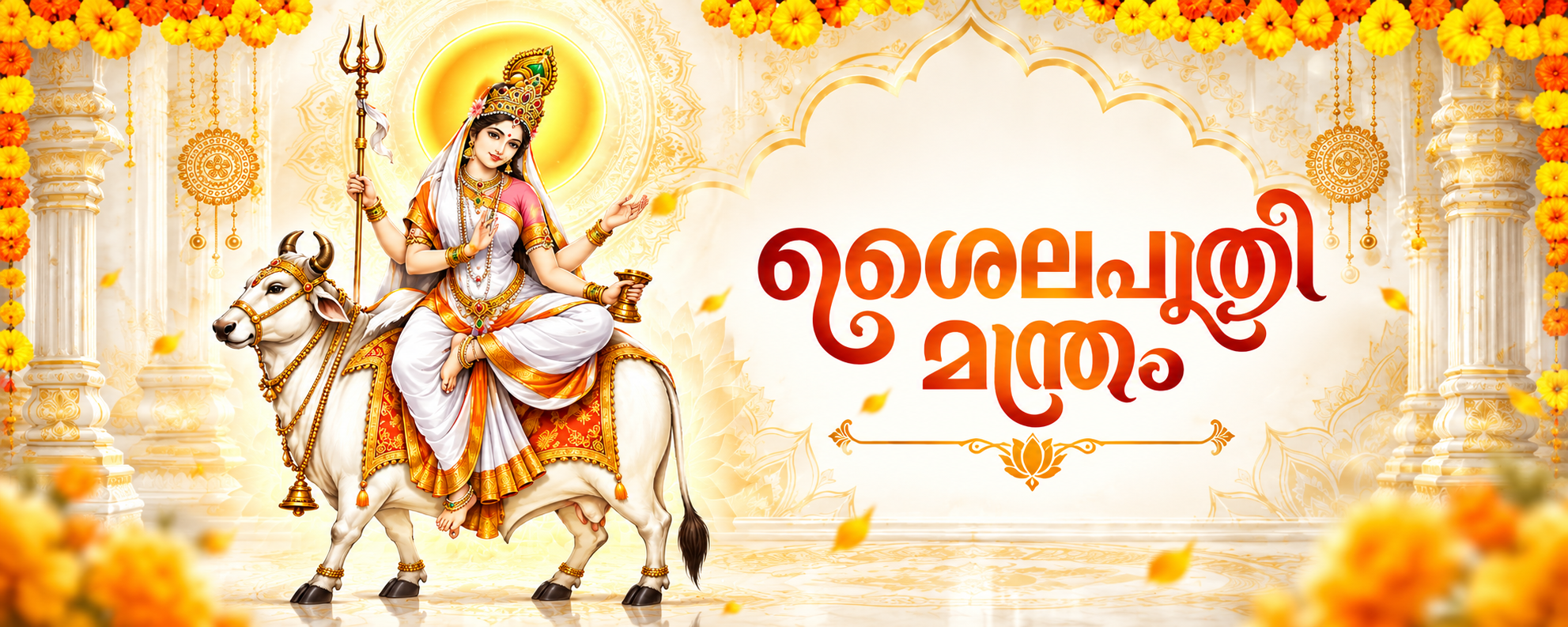
Navratri begins with Maa Shailaputri, the first of the nine forms of Durga. Her day is Pratipada, the first lunar day, when the nine nights of devotion begin. She is a form of Shakti, the consort of Lord Shiva, and the mother of Ganesha and Kartikeya. Yogis have always begun by laying a foundation, and her place at the start of Navratri reflects that.
Form of the Devi
Shailaputri holds a trident (trishul) in her right hand and a lotus in her left. She rides the bull Nandi. The trident stands for the three gunas (sattva, rajas and tamas), which she holds in balance. The lotus stands for purity that grows from the earth without being stained by it. Nandi, the patient and loyal bull, stands for steadiness and devotion.
What Shailaputri Represents
Shaila means mountain and putri means daughter, so her name means “daughter of the mountain.” A mountain is stable, silent and ancient. The Devi who bears this name is the strength that does not shake, the energy that has a firm base beneath it.
In yogic understanding, she presides over the Muladhara (root) chakra at the base of the spine. This is where kundalini rests, coiled and dormant, and where the inner journey begins. Without a stable root, nothing above it can hold. This is why she comes first.
The Legend of Sati and Parvati
In her earlier life she was Sati, the daughter of Prajapati Daksha. Daksha held a great yagna and deliberately left out Lord Shiva. Sati went anyway, and there she heard her husband insulted. Unable to bear it, she gave up her body in the sacrificial fire.
She was born again as Parvati, the daughter of Himavan, the king of the Himalayas. Because she was born of the mountain, she is called Shailaputri. In this life she turned toward tapasya and won Shiva’s hand through devotion. The story shows that what is lost to ego and insult is regained through patience and discipline.
Shailaputri and the Path of Kriya Yoga
Kriya Yoga is a gradual, systematic way of awakening the energy that Shailaputri represents. Its practices work together: asana, pranayama, meditation, mantra and devotion. Each of them begins with stability. A restless body and an unsteady breath cannot hold a deeper experience.
Three of her qualities map onto the Kriya path:
- The mountain is steadiness. A meditator sits like a mountain, unmoving and fully present.
- The root is the foundation. Rising energy needs a strong base. Practices that ground the body and calm the nervous system prepare the way for kundalini to move safely.
- The lotus is purity. As the practitioner’s awareness rises, it stays rooted in humility and devotion rather than in pride or striving.
The lesson is that spiritual progress is not about rushing upward. It is about becoming steady enough to receive what rises.
A Simple Practice for Day 1
- Sit comfortably with your spine upright. Let your weight settle into the ground.
- Take slow, even breaths. Feel the base of the spine as stable and supported.
- Mentally repeat the mantra: ॐ देवी शैलपुत्र्यै नमः (Om Devi Shailaputryai Namah).
- Rest in silence for a few minutes, with one intention for the nine days ahead.
May Maa Shailaputri bless every seeker with strength, steadiness and a firm foundation.